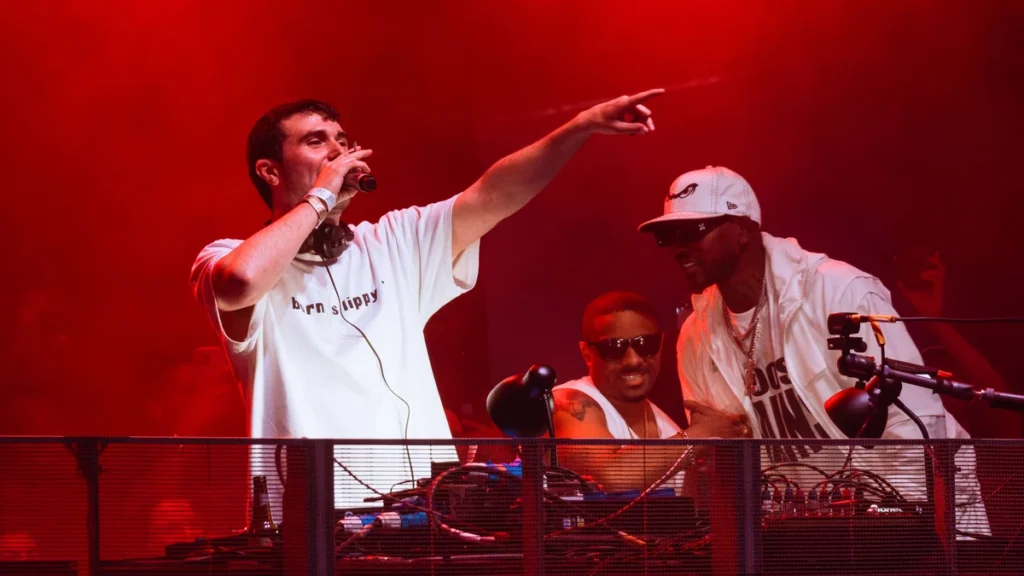
Starting on 3 October 2025, Fred again released a new track every Friday for ten weeks and played a show the same night, in a different city each time. Glasgow, Brussels, Madrid, Lyon, Dublin, Toronto, Chicago, San Francisco, Mexico City. No phones allowed in any of them.
His own comment on the pace is the most useful thing anybody has said about it. In November he wrote that he knew they were on more than a song a week, and that he absolutely did not care, adding that it feels alive and things are happening naturally so he is going with them.
What USB Actually Is
USB002 is the second in the series, a twelve-track project released a piece at a time rather than as an album with a date. The collaborations include Talk of the Town with Sammy Virji and Reggie, and HARDSTYLE 2 with KETTAMA and Shady Nasty.
The format takes its name from the thing a DJ actually carries. A working DJ’s USB stick holds unreleased edits, dubs and things that will never be cleared, and it is where club music lives before it becomes product. Releasing under that name is a claim that the material is functional rather than finished.
He has been open that it does not end. His Instagram note on the subject read that there were two more songs, maybe more, he did not know, and that usb is infinite.
No Phones
The phone-free policy is the part with the clearest effect on the room. It removes the incentive to film, which removes the incentive to perform for a camera, which changes what a DJ can do with a crowd for two hours.
It also removes the promotional loop that most electronic acts now depend on, where clips circulate and sell the next date. Running a ten-week tour with no footage coming out of it, and then announcing ten more shows on the strength of it, suggests the trade worked.
Ten More Nights
The additions are substantial: six nights at East End Studios in New York on 16, 17, 23, 24, 30 and 31 January, then four at Alexandra Palace in London across 12, 13, 26 and 27 February. Tickets went on sale in December.
Four nights at Alexandra Palace is roughly forty thousand tickets in one city, and doing it as a residency rather than a single date is a specific choice. It concentrates the audience into one room repeatedly instead of moving the production around, which is cheaper and, for a set built on continuous mixing, better.
Why the Weekly Cadence Is Hard
The schedule is more demanding than it sounds, because each Friday required two finished things rather than one. A track had to be mixed, mastered, cleared with collaborators and delivered to distributors, while a show had to be built, staffed and moved to a new country.
Collaborations make that considerably worse. Talk of the Town involves two other artists, HARDSTYLE 2 involves two more, and every one of those credits carries paperwork that normally takes weeks. Sustaining it for ten consecutive Fridays implies a team working to a standard that most labels would refuse to attempt.
It also means each track was heard in a club on the day it appeared, in front of an audience that could not have known it beforehand. That is the reverse of the usual sequence, where a record is tested privately, released, and only then played to people who already know it.
He Wrote a Third of the Number Ones
The career before this is the part people forget. Frederick Gibson was born in London in 1993, and by 2019 he held writing or production credits on thirty per cent of that year’s UK number-one singles. He was named Producer of the Year at the 2020 Brit Awards, the youngest person ever to take it.
The credits list is a run of very large pop records: Ed Sheeran’s Bad Habits, Stormzy’s Own It, George Ezra’s Shotgun, plus work with BTS, Clean Bandit and Charli XCX. He met Brian Eno at sixteen, through a family friend, after joining an a cappella group that met at Eno’s house.
An artist who has already succeeded completely inside the pop machine is unusually well placed to abandon its release conventions, because he has nothing left to prove by observing them.
The Diary Albums
The Actual Life series, three albums released between 2021 and 2022, established the method that USB now extends. They were assembled from real-world audio: voice memos, social media clips, recordings of people he knew, which he described as a collaborative diary.
Dated titles ran across each one, marking the period the material was gathered in. That is the same underlying idea as releasing a song every Friday, which is that a record should document a stretch of time rather than represent a finished statement about it.
Ten Days followed on 6 September 2024, with Skrillex, Four Tet, Anderson .Paak and Sampha among the collaborators. It is nominated for Best Dance/Electronic Album at the 2026 Grammys, and Victory Lap, with Skepta and PlaqueBoyMax, is up for Best Dance/Electronic Recording.
He Has Won Before
At the 2024 ceremony he won Best Dance/Electronic Album for Actual Life 3 and Best Dance/Electronic Recording for Rumble, made with Skrillex and Flowdan. He was also nominated for Best New Artist that year, a decade into a career that had already produced several number ones under other people’s names.
He finished 2025 at thirty-three in DJ Mag’s Top 100 DJs, which is a modest placing for someone selling out four nights at Alexandra Palace, and a reminder that the poll measures a different thing than ticket sales do.
Against the Algorithm
Releasing more than a song a week is a direct refusal of how streaming rewards artists, which is by spacing singles to maximise playlist adds and by holding an album back until a campaign is ready. Doing it while banning phones removes the other half of the machine.
That places him in the same argument as Chase and Status making a record explicitly about resisting the algorithm, though the tactics differ. One act wrote about the problem; Fred again simply started behaving as though the rules did not apply and let the ticket sales settle it.
The Dublin date was filmed for Apple Music and streamed from 31 December, which is the single exception to the no-cameras rule and a reasonable one. Everything else from those ten weeks exists only as the tracks, which was the point.
What makes the whole exercise coherent is that it is not really a marketing idea. A producer who has spent a decade inside major-label release planning knows exactly what the conventions are for, and has chosen to run the opposite experiment in public with his own money and his own calendar. The ten added dates are the result being reported back.
Whether it is repeatable is another question. Very few artists have the catalogue, the team or the standing to release unfinished-sounding club records weekly and fill a hall on the same night, and fewer still would want to. But it establishes that the schedule everyone else observes is a convention rather than a constraint, which is worth knowing.
About The Author