
AFAS Live is a 6,000-capacity room with a fixed proscenium and a deep stage, which makes it a straightforward venue for a band and a difficult one for a show built around projection. Sightlines are good, the ceiling is high, and there is enough depth behind the performer to hang a surface without pushing the front of house back. Those are the constraints Jean-Michel Jarre will be working inside on 21 October, when he opens the 30th Amsterdam Dance Event.
The concert is billed as Oxygène & Beyond: A Sonic Journey Celebrating 30 Years of ADE, presented by MOJO and Insomniac. It is the opening night of a festival that now runs 21 to 25 October, and it lands Jarre’s own fiftieth anniversary against the festival’s thirtieth in the same evening.
Fifty Years of Oxygène Meets Thirty Years of ADE
Oxygène was released in 1976 and became one of the first electronic albums to reach global commercial scale. That matters less as a sales record than as a structural precedent: it established that an instrumental synthesiser record with no vocal, no band and no conventional song forms could be sold to a mass audience, which is the commercial assumption the entire industry ADE convenes has been built on ever since.
ADE frames the pairing as a convergence rather than a coincidence. Its own announcement describes Oxygène as a lasting artistic experiment that shaped generations of the artists who have since played the festival, and positions the 30-year milestone as the point at which electronic music finished becoming a recognised art form with a working industry attached.
Whether or not you accept that framing, the booking is coherent in a way that a legacy slot often is not. Jarre is not being wheeled out to play a set of familiar tracks in front of a younger bill. He is opening the programme, which puts the oldest material in the room at the front of the week rather than in a nostalgia slot at the end of it.
The Production Brief in Jarre’s Own Words
Jarre has been explicit about what he intends to build. “Electronic music, as well as ADE, has a history, a legacy and a future,” he said of the show, describing an ambition to move from one track to another into a different atmosphere, different stage design, mapping, giant projections and architectures of lights.
Read as a technical brief rather than a press line, that describes per-track scene changes across a full set, with projection mapping tied to the arrangement rather than running as a continuous background. It is a significantly harder production problem than a fixed LED wall playing content, because every transition has to be cued against the music and the mapped surfaces have to hold their geometry while the lighting state underneath them changes.
It is also consistent with how Jarre has worked for decades. His large-scale outdoor shows were built around exactly this principle, using architecture as the projection surface and treating the light rig as part of the arrangement rather than a decoration on top of it. Bringing that into a fixed indoor room means losing the building and gaining precision.
What Per-Track Scene Changes Cost in a Fixed Room
The brief Jean-Michel Jarre describes is more demanding than it reads, and the difficulty is in the transitions rather than the looks themselves. A show that changes stage design, mapping and lighting state on every track has to hold three separate systems in sync: the audio timeline, the video playback, and the lighting desk. Each of those can run on its own clock, and in a room with a fixed truss position there is limited room to hide a cue that lands late.
The usual answer is timecode. The set is programmed against a master clock, the lighting and video systems chase it, and the performer plays to that timeline rather than the other way round. It produces very tight transitions and removes almost all improvisational latitude, which is why so many electronic live shows that look spectacular are effectively fixed performances with a musician on stage.
There is a second approach, which is to break the set into cued sections and trigger each transition manually, accepting a half-second of looseness in exchange for the ability to extend or shorten a passage on the night. It suits a performer working with a long-form catalogue, because it lets the arrangement breathe with the room rather than running to a stopwatch.
Which route a production takes is usually audible from the floor. A timecoded show has transitions that land on the beat with machine precision and never vary; a cued show has transitions that arrive slightly differently each night and occasionally hold a scene a bar longer because the room asked for it. Neither is better in the abstract. The choice determines whether the visual programme is serving the music or the music is serving the visual programme, and on an opening night in front of an industry audience that distinction is not a small one.
Why the ADE Pro Keynote Is the Other Half
The performance is only part of the booking. Jarre will also give an exclusive keynote interview at ADE Pro, the conference strand, focused on how electronic music has evolved and where it is going. Further appearances across the programme are still to be announced.
ADE Pro is the part of the week that separates this festival from a straightforward club weekender. It is where label deals, distribution arrangements, touring agreements and technology partnerships are actually negotiated, and a keynote slot there is a different proposition from a stage interview. Putting a composer who has spent fifty years solving live-production problems in front of that audience is a more interesting use of him than a retrospective panel would have been.
The Scale ADE Now Operates At
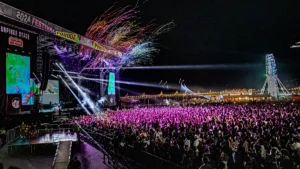
The size of the thing being celebrated is worth stating plainly. The 2025 edition carried more than 3,300 artists across close to 250 venues, with Charlotte de Witte, Adam Beyer, Skepta and Honey Dijon among the names on the bill. That is a city-wide operation rather than a festival site, and it runs for five days.
At that scale the programming problem is not booking talent, it is avoiding collisions. Nearly 250 rooms running simultaneously means the same audience is being split many ways every night, and the practical function of an opening concert is to give the week a single shared starting point before the city fragments into two hundred separate floors.
ADE describes itself as the world’s leading festival and business platform for electronic music, which is a claim, but the venue count makes it a defensible one. No other event in the genre convenes the label, booking, technology and artist sides of the business in one place at that density.
How the Ticketing Was Staged
Tickets for the Jarre concert went on sale on Friday 13 March through MOJO, with ADE Pro Early Bird passes opening two days earlier on Wednesday 11 March. Putting the professional passes on sale first is deliberate: the delegates travelling for the business programme book flights and accommodation months ahead, and they are the segment least able to make a late decision.
The seven-month lead time between the announcement and the event is long even by festival standards, and it reflects the production. A show built on mapped projection needs its content built against a fixed stage design, which cannot be finalised late without risking the whole visual programme.
What the Booking Says About the Programme
There is a reading of this announcement that treats it as a heritage gesture, and it would be the wrong one. The useful comparison is with how venues and promoters across the scene are now programming rooms for their acoustic and architectural properties rather than their capacity alone, which is the same instinct visible in fabric’s four-year booking at St Paul’s Cathedral. The room is being treated as part of the instrument.
Jarre’s ADE show is the indoor version of that argument. The material is fifty years old, the production techniques are current, and the point of putting them together on an opening night is to demonstrate that the two are not in tension. A festival celebrating thirty years of an industry has an obvious incentive to show that its oldest repertoire still functions on a modern system rather than surviving on affection.
More anniversary programming is still to be revealed, and the first artist announcements for the wider week have already begun landing. What is fixed is the frame: Jean-Michel Jarre opens, the record that made the commercial case for this music turns fifty, and the festival that turned it into an industry turns thirty on the same night. Full details are on the ADE announcement, with additional context in DJ Mag’s report.
About The Author