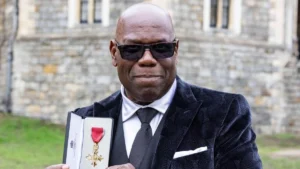
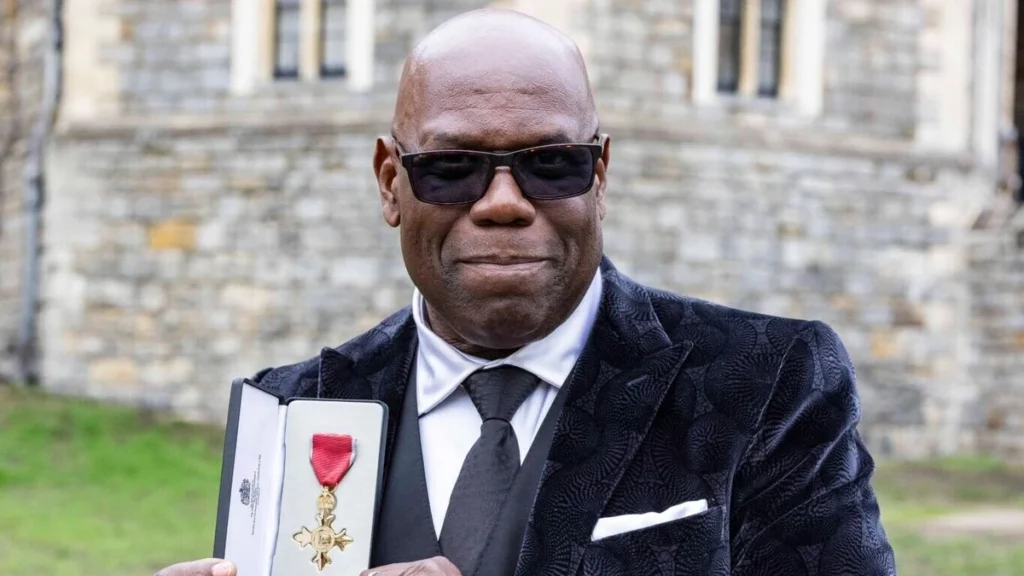
Most DJs work with two turntables: one record playing, the next one cued. In the 1980s Carl Cox added a third, and the three-deck mixing technique he pioneered became the signature of a career that has now reached Windsor Castle. On Tuesday, 10 November, Prince William presented Carl Cox with his OBE for services to music at an investiture ceremony there.
Cox flew back to the UK from a tour of the United States to collect the honour in person, wearing a bespoke morning suit by Ozwald Boateng, with his girlfriend and his sisters beside him. It is a landmark for the culture he comes from as much as for the man himself, and it arrives a year before he marks 50 years of DJing.
What Happened at Windsor Castle
Cox was named an OBE, Officer of the Order of the British Empire, in the King’s Birthday Honours List in June, for services to music. The investiture on 10 November was the formal presentation of that honour, Knights of the Turntable reported, having first reported the honour in June.
The OBE is a British honour awarded by the monarch, recognising a significant contribution to a field or outstanding service, Dubiks noted. For Cox, the citation is music, and the presentation came from Prince William rather than the King.
The detail of the trip says something about how he works. He returned from a tour of the United States especially for the occasion, Dubiks reported, and photographs from the castle grounds by Dan Reid show him holding the medal in its case.
What Carl Cox Said About the Honour
His statement after the ceremony was short. “This was an incredible day I’ll never forget,” Cox said, according to We Rave You. “I’m very proud and I know my mum and dad would be very proud of me too. I’m really happy to accept this. I’ve been doing this for many years and hope to continue for many more, sharing my love of music. I’m absolutely thrilled and deeply honoured.”
He said more in a post to his followers, reproduced by Sussex News. “Music has been my whole life. From those early days of falling in love with records and DJing, to travelling the world and sharing that love with so many people, I’ve never stopped being grateful that I get to do what I do,” he wrote.
He also wrote about his parents: “I’ve been thinking a lot about my mum and dad today. I know just how proud they would have been, and I wish they could have been here to share this moment with me.” He closed the post: “My heart is very full today. I’m proud, humbled and deeply honoured.” Congratulations followed from across the scene, with Tiësto and Charlotte de Witte among the artists commenting, We Rave You reported.
Three Decks and a Tuesday Night in Ibiza
The craft behind the honour is specific. Billboard described Cox in 2016 as a pioneer of the three-deck mixing technique in the 1980s. Running a third record alongside the usual two gives a DJ an extra layer to work with in a transition, so a percussion loop or a vocal can sit over the handover between two tracks, rather than one record simply replacing another. Done well on a big system, the floor hears one continuous arrangement built live.
In 2001 Cox agreed to a Tuesday night residency at Space in Ibiza and kept it for 15 summers under the Music is Revolution banner, Billboard reported. He founded his label, Intec Records, in 1999.
The residency ended on 20 September 2016 with a 10-hour set, the first six hours played entirely from his own vinyl. “I’ve never been involved in anything so deeply as I have been with the residency at Space,” Cox told Billboard that year. Describing the vinyl hours, he spoke of “putting the needle on the record and knowing that needle and that vinyl is rocking the house.” The same interview put his record collection, in 2016, at more than 150,000 pieces of vinyl, kept in a garage in Melbourne. The club itself closed after its lease ran out and the owner sold the site, Billboard reported.
The way he described those vinyl hours explains the craft better than any citation. Mixing from a record box meant testing pairs of tracks live and remembering which ones worked. “Do these two records mix? Yeah they do, wow. Okay,” Cox told Billboard. “You made a mental note of that, and then sometimes you play your set and you say, ‘I wanna play those two records again like you did last week,’ but you can’t find the other record you mixed.” A DJ working that way builds a set from memory, tempo and ear, and that craft sits behind the citation.
By 2016 he was also hosting and programming his own stages at festivals, including Ultra and Awakening, Billboard noted. The pattern is the same at every scale: the set is planned around the room, and the room tells you when the plan needs to change.
Why the Honour Matters to Club Culture
Cox framed the OBE as recognition for the music, not just for himself. “This honour means so much, not just to me personally, but because of where our music has come from and how far it has travelled. To see dance music recognised in this way is something I’m immensely proud of,” he wrote.
Knights of the Turntable made the same point about the setting, arguing that for a culture born in underground clubs, warehouses and soundsystems, seeing one of its defining figures honoured at Windsor Castle carries particular weight. It traced his career from the early days of disco and the emergence of acid house in Britain to the global spread of techno, and noted that he has championed underground artists and emerging talent throughout.
The site also credited his reputation to the dancefloor itself, where his energy and technical ability made him one of the most recognisable DJs in the world. It signed off its report with the line his fans know best: “Oh yes, oh yes!”
That is the useful way to read the honour. Honours for services to music are more often associated with composers, conductors and pop stars. Giving it to a DJ whose instrument is a set of decks and a sound system recognises that mixing records for a room is a musical craft in its own right, with its own technique, its own history and its own masters.
A Year of Royal Moments
The investiture caps an unusual year for him. Cox also met King Charles at Buckingham Palace earlier in 2026, We Rave You reported, while still finding time in the studio to revive a Renegade Soundwave classic. He remains the man behind [UNVRS] Ibiza, keeping an island connection that runs back through his years at Space.
Sussex News described the OBE as recognition of nearly 50 years of contributions to electronic music and club culture. His own post used the same measure, calling the honour recognition of “nearly 50 years of doing something I absolutely love.”
Fifty Years Behind the Decks Next Year
The round number arrives in 2027, which marks 50 years since he began DJing, according to Knights of the Turntable. After almost five decades, the site noted, he remains as active as ever, which the US tour he flew back from bears out.
British club history is full of rooms that shaped the DJs who came after them, from the warehouse parties of the acid house years to the weekly nights of the 1990s. This site recently looked at how Kev’Laa learned the floor at Cream, the Liverpool night that ran from 1992 to 2002, before making records for that kind of crowd.
Carl Cox played through all of that history and kept going. The medal from Windsor Castle is a formal line under the first 50 years; on the evidence of the trip home from the US to collect it, the next set is never far away.
About The Author