Half of Bonobo’s new album has somebody else singing on it. Seven of its fourteen tracks carry a guest vocalist, and no two of them come from the same corner of music.
Distance in Static arrives on 11 September through Ninja Tune, following Fragments from 2022. Simon Green has also announced a new live show and a North American tour running from November.
Seven Singers, Seven Different Worlds
The list is worth reading in full because of how little the names have in common. Arooj Aftab appears on “Fire on the Water”. Nicole Miglis of Hundred Waters takes “Talk to Me”. Joy Crookes sings “Always on Your Side”, Nilufer Yanya “Youth’s Fountain”, Aanya Martin “Can’t You See”, Ichiko Aoba “Equinoctial” and Kanako Yamamoto “Mercury”.
That spans Pakistani-American contemporary classical and jazz-adjacent songwriting, Florida art-pop, South London soul, British indie rock, and two singers working in Japanese. It is not a feature list assembled for reach, because a list assembled for reach would overlap far more.
The producer-with-guests album is a well-established form and it usually fails the same way: the vocalists become interchangeable, the tracks become showcases, and the record stops being an album and becomes a compilation with one name on the sleeve.
What separates a good version is whether the guests are chosen for what they specifically do rather than for what they bring in. Seven singers this dissimilar cannot be interchangeable, which at least removes the most common failure mode before the record starts.
It also means seven tracks that will not behave like the instrumental ones. A vocal changes the arithmetic of an arrangement — it takes the midrange, it demands space, and it turns a piece built on texture into a song with a structure. Our piece on the arrangement rules club tracks follow covers what changes when a voice arrives.
A Title About Not Being the Current Reference
Green’s explanation of the album’s name is the most revealing thing he has said about it, and it is not really about the music.
“I think the front end of what I’ve done has now become something that’s referential to younger people,” he said in the press release. “I liked the idea of listening for a distant signal — trying to find something in the noise.”
That is an artist noticing that his early records now function as somebody else’s influence. Bonobo’s first album came out in 2000; a producer who started listening to it as a teenager is in their thirties now, and the sound Green built has been absorbed into the general vocabulary of the music.
Most artists in that position either lean into the legacy or work hard to distance themselves from it. Naming the album after the experience of straining to hear a faint signal is a third response — treating the distance itself as the subject rather than a problem to solve.
The tracklist supports the reading. “Dawn”, “Cycles”, “Drift”, “Uncasually”, “Shokoufeh”, “ID700”, “Equinoctial” — these are titles about states and processes rather than events, on a record explicitly concerned with what reaches you across a gap.
The Lead Track Was Already Working in Clubs
The album is led by “Me and You”, which Pitchfork described as a staple of Green’s recent club sets. That is a specific and useful piece of information about how the record was made.
A track road-tested in DJ sets before release has been through a form of testing most studio music never gets. The producer has watched a room respond to it repeatedly, in different cities, at different points in a night, and has had every opportunity to change what did not work.
It is also a very old method being applied to a modern release. Dubplates and white labels existed precisely so a producer could test a record on a crowd before committing to a pressing; playing an unreleased track in your own sets is the same practice with the manufacturing removed.
Choosing it as the lead is a low-risk decision as a result. Whatever else happens to the album, one track on it is already known to work.
It also tells you something about the shape of the record. “Me and You” sits at track twelve, deep into the sequence, which means the club-tested piece was not placed to grab a listener early. On an album about faint signals, putting the most immediate thing three quarters of the way in is a choice about pacing rather than about singles.
The instrumental tracks are distributed the same way. “Dawn” and “Cycles” open without a voice, “Drift” and “Uncasually” sit between the first two vocal features, and “Shokoufeh” and “ID700” break up the back half — so the guests punctuate the record rather than dominating it.
What He Did Between Albums
The four years since Fragments were not empty. Green released a soundtrack with Kamasi Washington and Floating Points for the anime series Lazarus — a three-way collaboration between a jazz saxophonist, an electronic producer with a neuroscience doctorate and Bonobo.
Soundtrack work suits his method. Bonobo’s records have always been built on organic instrumentation inside electronic arrangements, and scoring rewards exactly that — the ability to write something that carries emotional weight without a vocal in front of it.
That background makes the seven guest singers on the new album more interesting, not less. A producer who has just spent a project proving he can work without voices choosing to fill half of his next record with them is making a deliberate move rather than a default one.
Green has been releasing since 1999. He turned down deals with XL Recordings and Mute early on to stay with the Brighton independent Tru Thoughts, which released his debut Animal Magic in 2000, before the long association with Ninja Tune that continues here.
Turning down two of the most desirable labels in British music at the start of a career is the sort of decision that only looks correct in retrospect, and it is worth noting alongside the album’s theme. An artist who chose the smaller signal at the outset is well placed to write about listening for a distant one twenty-six years later.
The career since has moved from trip hop toward jazz and world-music influences without ever fully leaving the first thing behind, which is why the early records remain legible to people who found them recently. That continuity is exactly what makes a back catalogue into a reference point.
A New Live Show, Not Just a Tour
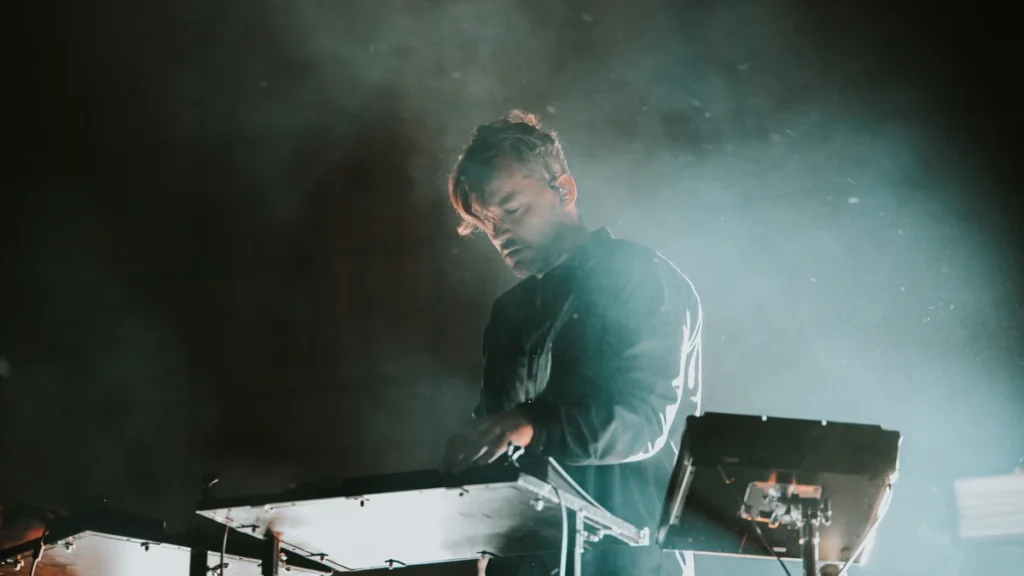
The North American dates opening in November are billed as a new live show rather than a promotional run, which for Bonobo is a meaningful distinction.
His electronic material is performed by a full band rather than triggered from a laptop, so a new show means new arrangements for players, not a new visual package around the same set.
The itinerary is a club and theatre run rather than an arena one — Emo’s in Austin, the Wiltern in Los Angeles for two nights, the Fox in Oakland, Radius in Chicago, the Paramount in Brooklyn — the kind of routing that suggests a show built for rooms where the arrangement can be heard.
It raises an obvious question the tour will have to answer, which is what happens to seven guest vocals on stage. Half a record that depends on specific singers is a real problem for a touring band, and how it is solved usually tells you what the producer thinks those parts are for.
Distance in Static is out on 11 September through Ninja Tune.
About The Author