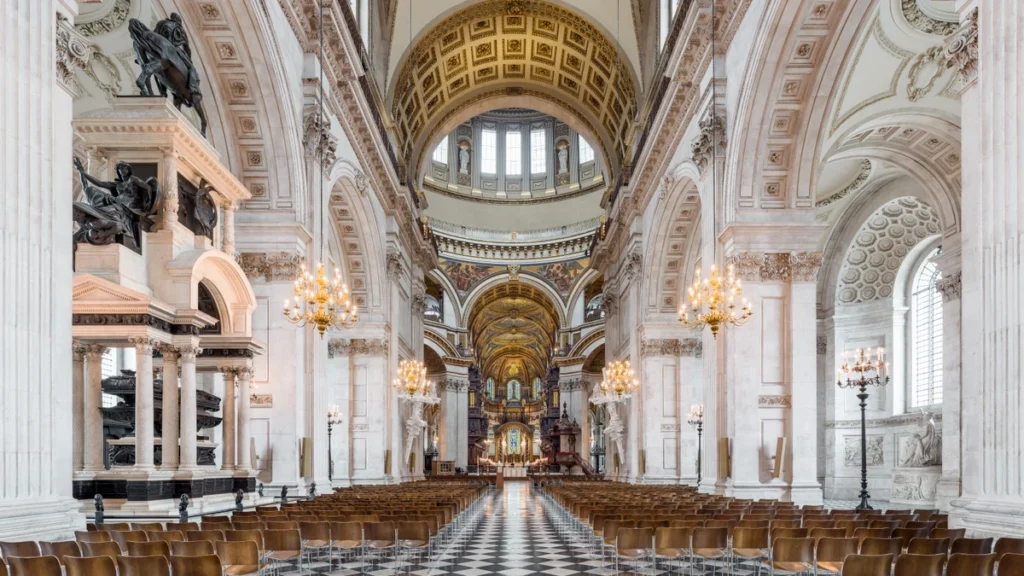
The nave of St Paul's Cathedral
The nave of St Paul's Cathedral
Farringdon to Ludgate Hill is under a mile on foot. On one end sits a club that has spent a quarter of a century arguing that a room’s physical properties are part of the music. On the other sits Christopher Wren’s dome. From this year until 2030, fabric is St Paul’s Cathedral’s exclusive partner for contemporary music events.
The first night of the new deal is 29 October. The artist has not been named, and fabric has said only that a very limited number of tickets will be available. The announcement came from both sides on 1 September, which is unusual in itself: a cathedral and a nightclub issuing a joint press release is not a routine occurrence.
What the Deal Actually Covers
Exclusive is the operative word. The cathedral’s own announcement confirms that fabric becomes its exclusive partner for contemporary music events from 2026 through to 2030, which means the club is not one promoter among several but the route by which any contemporary artist reaches that room for the next four years.
That is a meaningful amount of programming control to hand to a single operator, and it explains why the deal runs to four years rather than one. Building a series inside a working cathedral is not a matter of booking dates: it requires the building’s schedule, its clergy and its visitor operation to be part of the plan.
Sandra Lynes Timbrell, the cathedral’s Director of Visitor Engagement, framed the aim in terms of reach: the hope is that a carefully curated programme will “introduce new visitors to the Cathedral, encouraging people to discover and engage with this historic building in new and exciting ways”. That is a visitor-strategy objective as much as a musical one.
Two Events Made the Case
The partnership did not start from nothing. fabric’s own account is that the relationship began in 2024, when the club presented RY X at the cathedral — its first event in the space, and, in fabric’s words, a rare opportunity to experience electronic music within one of London’s most iconic buildings.
It returned in 2025 with an intimate performance from Patti Smith. Those two bookings are instructive about the range being aimed at: an ambient-leaning electronic artist and a figure from a completely different tradition, both suited to a room where reverb is measured in seconds rather than milliseconds.
Cameron Leslie, fabric’s co-founder, described the appeal plainly: “fabric has always been about bringing people together through music and creating experiences that stay with people. The opportunity to do that at St Paul’s Cathedral over the next four years is incredibly exciting for us.” He called it “an extraordinary and unexpected coming together of two very different parts of London”.
The Building Is the Instrument
The stated intention is that each event responds to the cathedral’s acoustics, architecture and atmosphere rather than treating it as a neutral shell with a good ceiling. That distinction is the whole technical argument, and anyone who has tried to mix in a large stone building knows why.
A space like this has an extremely long reverberation time. Transients smear, low end builds where the geometry says it will, and any material that depends on rhythmic precision arrives as mush. The room actively rejects the kind of programming a club does every weekend, which is why a four-year series has to be curated rather than booked.
What the space rewards is sustain: drones, choral textures, slow harmonic movement, single instruments given room to decay. That is a real constraint on who can play, and it is also the reason the results can be extraordinary when the match is right. The building does half the work, provided the music lets it.
Why fabric Keeps Leaving Its Own Building
This is not the club’s first landmark. Mixmag noted that fabric has run events at The Shard, London’s tallest building, and at the British Museum in Holborn, alongside its own venue.
There is a straightforward commercial logic. A club has a fixed capacity and a fixed number of nights, and its revenue ceiling is set by both. Programming other people’s buildings adds capacity without adding overhead, reaches audiences who would not queue in Farringdon, and attaches the brand to institutions that carry their own credibility.
The less obvious benefit is durability. Independent clubs in London have had a punishing decade, and an operator whose expertise is portable — knowing how to programme, produce and sell an event in an unusual space — is less exposed than one whose entire value sits in a single lease. ElectronicMusic.News covered a similar broadening when Paul van Dyk took on five emerging producers directly: established names finding new ways to use what they have built.
Where the Two Institutions Actually Meet
The pairing looks incongruous and is less so on inspection. Both organisations are in the business of putting people in a room together and shaping how that room makes them feel, and both have spent decades refining the physical apparatus for doing it. One does it with a bodysonic dancefloor and a sound system built into the structure; the other with stone, a dome and several centuries of practice.
Leslie’s phrase for it — an extraordinary and unexpected coming together of two very different parts of London — is doing more work than a press quote usually does. Farringdon and Ludgate Hill are close enough to walk between in under twenty minutes, and the two buildings have coexisted without acknowledging each other for the club’s entire existence. The distance being crossed here is cultural rather than geographic.
There is a practical dimension too. Contemporary music inside religious buildings is not new — churches have hosted concerts for as long as they have had organs — but the version being described is not a hire agreement in which a promoter books a hall and the building stays out of it. The stated design principle is that the cathedral shapes each performance, which makes the venue a collaborator rather than a landlord.
The four-year framing is what turns that from an aspiration into a programme. A promoter with one date can only book someone who already suits the room. A promoter with four years can commission work for it, which is a different and considerably more interesting proposition, and it is the outcome worth watching for rather than any individual booking.
What the Cathedral Gets
The institutional side is worth taking seriously rather than treating as a curiosity. Cathedrals have a demographic problem that no amount of heritage marketing fixes, and a contemporary music programme reaches people who would not otherwise cross the threshold. The cathedral’s stated commitment is to welcoming diverse audiences and creating opportunities to experience the building through music, culture and the arts.
There is a risk on that side too, and it is not financial. Handing exclusivity to a nightclub invites a certain amount of comment, and the programme has to be good enough that the pairing reads as serious rather than as a stunt. RY X and Patti Smith were both credible bookings, which is presumably why the deal exists at all.
The four-year term also matters institutionally. A one-off is an experiment that can be quietly dropped; a four-year exclusive is a commitment that has to be defended internally, which suggests the earlier events performed well enough on the measures the cathedral actually cares about.
What to Watch on 29 October
The first booking will tell you what the next four years look like. An ambient or modern-classical artist would confirm the safe reading of the space. Something with an actual pulse in it would be the more interesting signal, because it would mean the production side believes the acoustics can be solved rather than only accommodated.
Ticketing is the other thing to watch. fabric has flagged a very limited number of tickets, which for a room of this size implies a deliberately small configuration rather than a sell-everything approach. That points to a series positioned as rare rather than recurring.
Either way, the more useful precedent may be for everyone else. If a Grade I-listed cathedral can hand its contemporary programming to a nightclub for four years, the list of buildings that are off-limits to this kind of event is shorter than most promoters assume.
About The Author