From 2009 to 2018, Drum & Bass Arena gave its best DJ award to the same person every single year. Ten consecutive wins in a genre with no shortage of competitors is not a run so much as a category error, and it is one reason Andy C is routinely described as the godfather of drum and bass.
The total across his career is over forty awards. He has sold out Alexandra Palace and Brixton Academy on his own, headlined Creamfields, Glastonbury, EDC and SW4, and in 2018 became the first drum and bass artist ever to headline Wembley Arena.
Three Turntables
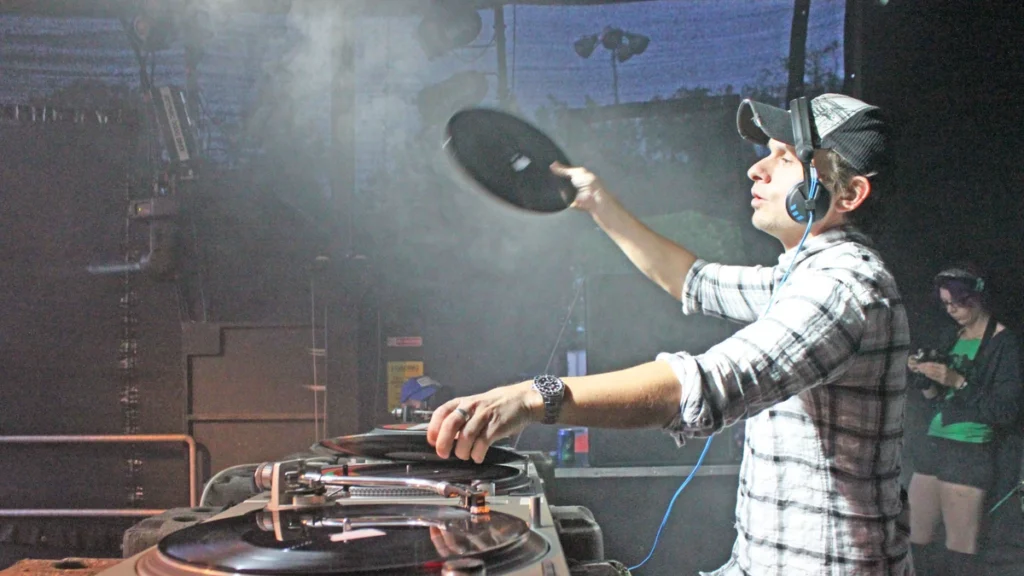
The technical reputation rests on something specific. He mixes on three analogue turntables rather than two, and is associated with the double drop, which aligns two records so their drops land at the same instant.
Doing that with vinyl on three decks is a different discipline from doing it with sync software. The tracks have to be beat-matched by hand and held there while a third is cued, and the drop has to be timed to a fraction of a beat or the whole thing collapses. It is the reason he is a DJ’s DJ as well as a festival headliner.
His Sister Named the Label
The origin is almost too neat. Andrew Michael Clarke, born in Walsall in 1976, finished school and was told by his mother to get a job. His sister suggested starting a record label instead, proposed the name RAM Records, and drew the original logo in felt tip pen. He was sixteen.
The first release arrived while he was on his first holiday to Magaluf, and his father collected him from the airport with the debut pressing in the boot of the car. It was 1992. The label is still running.
The route in was ordinary for the time and place: his sister took him to his first rave at thirteen, in a barn; he grew up on pirate radio in Essex; he spent so much time in a record shop in Romford that they gave him a job. He bought Audio-Technica belt-drive turntables with his savings and a loan from his parents.
Valley of the Shadows
The breakthrough came in 1993 with Valley of the Shadows, made as Origin Unknown with Ant Miles. It is also known as 31 Seconds and as Long Dark Tunnel after the samples it uses, which tells you how thoroughly it entered the genre’s shared vocabulary.
It was written in four hours. The drums came from a free CD given away with Future Magazine, and it was originally a B-side. It became one of the label’s best-selling and most recognisable records, which is a useful corrective to any theory that the canonical tracks of a genre are the carefully considered ones.
The Label Did the Rest
Ram is arguably a larger contribution than the DJing. Its roster developed Chase & Status, Sub Focus, Wilkinson and Loadstar, which is a substantial share of the artists who took drum and bass into the British mainstream, and the sister labels Frequency and Program were launched in 2002 and 2012 to widen the intake further.
The signings happened in unglamorous ways. Sub Focus handed over a demo CD at a gig with one digit of his phone number barely legible, so Andy C worked through the variations until somebody answered. He met Chase & Status in a Chinese restaurant in Church End and remembers them talking about wanting big albums and sold-out arenas. He first heard Wilkinson’s Afterglow in his own kitchen, having just made a cup of tea, and says the track blew his mind.
That is a specific kind of label achievement. Ram did not simply release records by people who were already good; it took producers early and kept them through the period when their sound became commercially viable. Every one of those four went on to have hits far outside the genre’s core audience.
The relationship also cuts the other way. Chase and Status, now making albums about resisting the algorithm, are working from a platform Ram built, and their continued prominence is part of what keeps the label’s catalogue current.
How He Decides What to Sign
His stated A&R method has no criteria in it. He describes it as finding a moment that really talks to you, whether that is a synth arrangement or a chord sequence, which is either uselessly vague or the only honest description of the job depending on your view.
What he does with demos he turns down is more instructive. He gives feedback, on the reasoning that you can hear great things in a demo that is not right for release, and that responding is a way of giving the artist confidence. A label boss who replies to rejected demos is doing something structurally different from one who does not, and over thirty years it compounds.
The club nights worked the same way. Ram ran parties every couple of months at The End in London from around 2003, with the DJ booth in the middle of the room surrounded by the crowd, which he has called legendary. During the pandemic he held releases back, saying it did not make sense to put out songs made for parties when nobody could go out, and ran virtual parties instead that reached tens of thousands.
The Crossover Records
His own releases have periodically broken out. Body Rock, with Shimon in 2001, reached twenty-eight in the UK. Heartbeat Loud, featuring Fiora in 2014, went to number ten and was certified gold. Indestructible, with Becky Hill in 2024, was certified silver and reached the top twenty of the UK dance chart and eighth on the Official Big Top 40.
Alongside those sit Ricochet and more recent club material including Who Like The What? and Positions. The pattern is a producer who releases a crossover record every few years and otherwise makes tracks for the floor, which is the correct ratio for someone whose primary job is DJing.
A Hologram at Drumsheds
Andy C ALiVe began in 2012 as a way of turning a DJ set into a production, combining mixing with synchronised visuals. The third version, ALiVe 3.0, debuted at Drumsheds in 2024 and added a hologram backdrop.
The show now travels with custom track selections, exclusive remixes and its own staging, and it reaches HARD Summer in Inglewood on 2 August 2026, the first time the concept has appeared at a HARD event. Before that he plays BERHTA in Washington on 31 July and Club Vinyl in Denver on 1 August, and he appears at Beats for Love and at Uprising in late August.
Building a branded show around a DJ set solves a problem the genre has had for years. A drum and bass headliner playing a festival stage is one person behind equipment for ninety minutes, which is hard to sell at arena scale no matter how good the mixing is. Attaching a production to it is what made Wembley possible.
Three Decades In
He entered DJ Magazine’s Top 100 at sixty-one in 2010 and took the poll’s highest drum and bass placing at seventy-nine in 2019, which are modest numbers for someone with his standing and mostly reflect how that poll is voted rather than how the genre regards him.
The more telling measure is the ten-year run at the specialist award, because that is decided by people inside the form. A DJ who is voted the best in his genre every year for a decade is not being rewarded for novelty; he is being recognised for a technical standard nobody else reached.
Thirty-three years after Valley of the Shadows he is still touring, still running the label, and still using turntables. The hologram is new. The three decks are not.
About The Author