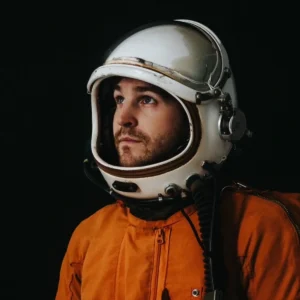
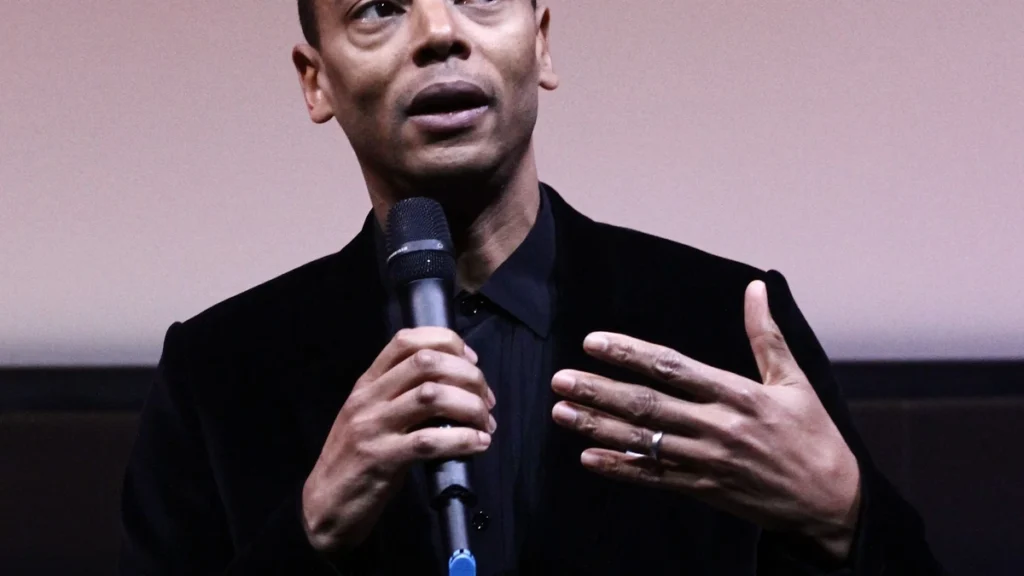
A Roland TR-909 has eleven voices and no ability to suggest anything. It produces a kick, a snare, hats, toms and a handful of cymbals, all of them analogue except the cymbals, and it does not do texture. Jeff Mills has spent four decades using one to describe space travel, and The Trip To Vega, released on Axis Records on 19 June, is set in the year 2097.
Eleven tracks, on triple vinyl and digital. The premise, per Resident Advisor, is humanity leaving Earth after environmental collapse and neurological degradation caused by tectonic activity. Destination Bright Star, Omega Dust Rings, Twenty-Five Light Years Away, Terraform, Circumstellar Debris: the titles carry the narrative, because the music has no words in which to do it.
Science Fiction Without Lyrics
That constraint is the interesting engineering problem in all of Mills’s conceptual work. A film score can rely on what is on screen. An instrumental techno album set in a specific year, with a specific catastrophe behind it, has only tempo, timbre, arrangement and titles to work with.
What that produces in practice is music organised around distance and repetition rather than tension and release. A track like Orbiting The Star has to imply something circular and enormous, which means resisting the drop that a club record would build toward. Mills has been solving that problem since the 1990s, and the solution has consistently been to let a pattern run long enough that the listener stops waiting for it to change.
The 909 is central to why that works rather than incidental to it. Its sounds are short, dry and almost entirely without sustain, so a pattern built on one leaves the rest of the frequency spectrum empty for something else to occupy. Producers who reach for sample libraries instead end up with kicks and snares carrying reverb tails and room tone they did not choose, and those tails fill exactly the space a long synth line needs. Mills has kept the machine because it leaves room, not for nostalgia.
The Wizard, Before Any of It
Mills was born in Detroit in 1963 and left Mackenzie High School in 1981. He started as a radio DJ under the name the Wizard, doing beat juggling and scratching on nightly shows at WDRQ and then WJLB, and he used the airtime to play local producers including Derrick May, Kevin Saunderson and Juan Atkins before anyone outside the city knew the names.
The detail that explains the rest of his career is the record budget. He would drive to Toronto or Chicago to buy new releases for those shows. A DJ who physically travels several hundred miles for material is building a library rather than a set, and Axis Records, founded in 1992, is what that instinct looks like once it has an outlet.
Underground Resistance and the Move Out
In the late 1980s he co-founded Underground Resistance with Mike Banks and Robert Hood, a collective that presented itself in ski masks and combat gear and framed techno in explicitly political terms. Mills stepped back in 1991 to work alone, though he never formally left.
Then came the moves: Detroit to New York, New York to Berlin as a resident at Tresor, Berlin to Chicago, where he started Axis with Hood aiming at something more minimal. That geography matters because it maps the route techno itself took in those years, from an American invention to a European institution and back.
The Tresor residency in particular is a piece of infrastructure history rather than a line on a CV. Berlin in the early 1990s had empty industrial buildings and no licensing regime worth the name, which meant rooms that could run all night at volumes no American club would permit. Detroit producers who played there were hearing their own records on systems built for exactly that music, often for the first time, and a great deal of what became the European techno sound came out of that feedback loop.
The Mix That Defined a Format
Live at the Liquid Room, Tokyo, recorded in 1996, is the record most people mean when they say Mills changed what a DJ mix could be. Thirty years on he has been touring an anniversary version of it, playing Asia around the album release with dates in Vietnam, Singapore and Malaysia, after earlier shows in London, Osaka, Tokyo, Hong Kong and Paris.
The technique behind it is worth stating plainly, because it is unusual even now: three decks, a 909 running alongside them, and as many as seventy records in a single hour. That is a track roughly every fifty seconds, which makes the 909 not an accompaniment but the connective tissue holding the mix together while the records rotate underneath. Mixmag has called him the master of the machine, and he moved to three or four CD decks for most club work around 2011 without changing the approach.
Orchestras, Silent Films and the Louvre
The catalogue outside the clubs is substantial. Metropolis in 2000 was a score for Fritz Lang’s 1927 film; Woman in the Moon in 2014 did the same for Lang’s 1929 one. Blue Potential in 2006 was recorded live with the seventy-piece Montpellier Philharmonic Orchestra. Where Light Ends in 2013 took its starting point from the astronaut Mamoru Mohri’s first spaceflight.
He has also worked in film with Jacqueline Caux, and made Life to Death and Back during a four-month residency in the Egyptian wing of the Louvre. In 2017 the French culture ministry gave him the Ordre des Arts et des Lettres. In 2018 he recorded an EP with the drummer Tony Allen. None of that is a departure from the techno records; it is the same preoccupation with scale and time, given more instruments.
Billboards Asking a Question
Last year Axis put four billboards up around Detroit, on Woodward, Jefferson and Gratiot, each carrying the words “This Is Techno” beside two futuristic images. There was no product being advertised. Mills described the intent as sharpening the ability to detect what is techno and what is not, and compared the paired images to a Rorschach test pointing at an unseen third image that exists only in the viewer’s head. “A stretched imagination is the goal,” he said.
Buying outdoor advertising in your home city to pose a definitional question about your own genre is an unusual use of a marketing budget. It is also consistent: an artist whose albums are set in specific future years is going to treat the question of what the music is for as unfinished business.
The Label as the Point
The Trip To Vega followed Whatever The Case, an EP in the Axis Expressionist Series, which is one of several parallel strands the label runs. Thirty-four years in, Axis functions less as a distribution channel than as the structure that makes the conceptual work possible at all: nobody else was ever going to commission an eleven-track album about tectonic collapse in 2097.
That is the same logic now visible one generation down, in the way Sara Landry releases her albums through the imprint she founded rather than through anyone else’s. Mills got there first and has been demonstrating the argument for three decades: own the release mechanism and the strange records get made.
About The Author