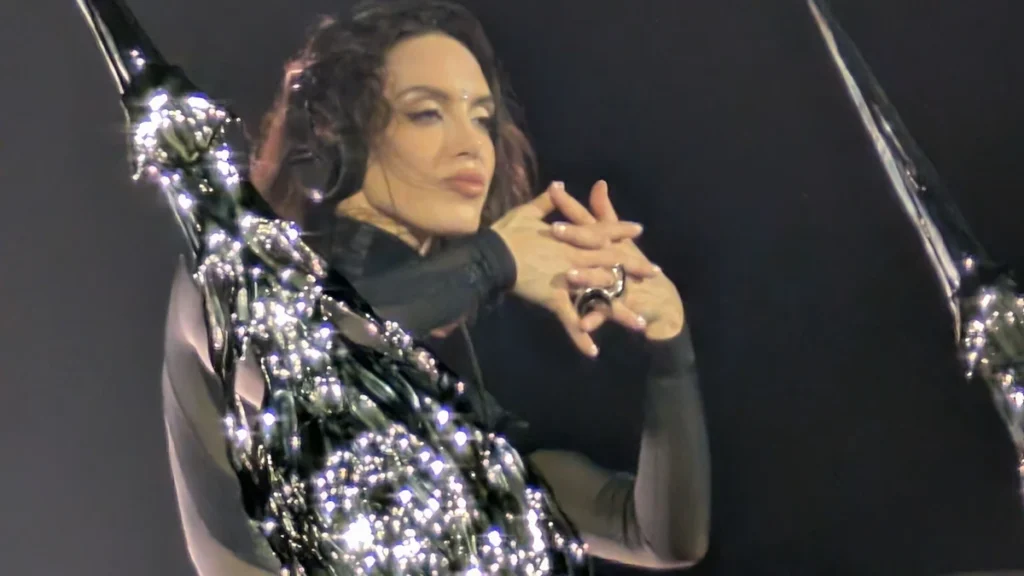
On Interesting, the fourth single from Divine Intervention, the vocal is Sara Landry talking rather than singing, mixed close enough that you can hear the room. That is a production decision with a specific consequence: a spoken line sits in the midrange where a hard techno mix is usually kept clear for the kick and the synth stabs, so making room for it means pulling something else back.
Landry made that call herself, because she engineers her own records. The album arrives on 16 October through HEKATE, the label she founded in July 2021, which means she also decided when it comes out and what goes on it. For a genre where the artist-label-engineer chain is normally three separate parties, that concentration is unusual.
Four Singles, Four Months
The rollout has been steady rather than explosive. Hands Up, with Alt8, came in June. Shake That followed on 17 July, built on a heavy bassline against sharp synths. Angel Dust, a collaboration with Alex Farell, arrived in August and carried the album announcement. Interesting lands on 4 September, six weeks before the record.
That last one is the most revealing about where she is heading. Rave Jungle described it as fusing hardstyle with hard techno, over glitchy synths and a spring-loaded bassline. Landry’s own account of it was straightforward: “I really wanted to have some fun with this one, and I did. It’s a little edgy and a little cheeky with a whole lot of bass.”
Hardstyle Bleeding Into Hard Techno
That fusion is worth taking seriously as an engineering matter rather than a genre label. Hardstyle is built on a distorted, pitched kick that carries the harmonic content, so the bass and the drum are effectively the same element. Hard techno keeps them separate: a clean low kick, with the aggression coming from the mid and high frequencies.
Combining them forces a choice about which part of the spectrum carries the weight, and it is the sort of problem that gets solved at the mixing stage rather than in the arrangement. It is also why the two scenes, despite overlapping tempos and crowds, have historically produced records that sound nothing alike on a large system.
The tempo range is where they actually meet. Both sit comfortably above 150 beats per minute, fast enough that a bar passes in under two seconds, which changes what an arrangement can do. There is no room for a slow build across sixteen bars, so transitions happen through filtering and drops rather than through gradual layering. Producers working at that speed tend to write in short blocks and rely on texture for variation, and that is audible across the four singles: each one establishes its idea inside the first thirty seconds.
The Label Came Before the Albums
HEKATE started in July 2021, named after the Greek goddess associated with witchcraft, crossroads and the night. It predates both of her albums. That sequence matters: she built the release mechanism first, then made the records to put through it, which is the reverse of how most artists arrive at running a label.
It has not stayed a vanity operation either. HEKATE has released Nico Moreno, Shlomo, Charlie Sparks and blk. alongside newer producers, which makes it a functioning imprint with an A and R position rather than a self-release channel. Her debut album, Spiritual Driveby, came out on it in 2024.
Running a label while touring at this volume is a real operational load, and most artists who try it either sign nobody or quietly wind it down. HEKATE has done neither, and the roster choices point at a specific position within hard techno rather than a broad net. Signing established names alongside newer producers also gives the imprint something a self-release channel never has: a reason for people to check the catalogue rather than just the artist.
How She Got There
Landry was born in Sausalito, California in 1993, moved to Boulder at three and then to Austin. At seventeen she went to New York to study and started DJing while working as a promoter, which is the more instructive half of that sentence: promoters learn what empties a room. Back in Austin she played Kingdom, Plush, Parish and the Vulcan Gas Company.
Her first single, Chasm, came in 2018. In 2019 she signed to Mau5trap and released an EP called Wait. She moved to Amsterdam in 2022, which put her inside the European circuit rather than flying to it, and by 2024 she was ranked 75th in DJ Magazine’s Top 100 poll and was the genre’s top-selling female producer on Beatport.
The Sets That Travelled
The streaming numbers on her recorded sets are the clearest measure of reach. Her Boiler Room appearance with Teletech passed ten million views and was the third most-streamed Boiler Room set of 2023. A Knockdown Center set in New York reached 2.6 million, Tomorrowland in 2024 1.8 million, and her EDC Las Vegas sets in 2024 and 2025 drew 819,000 and 875,000 respectively.
Those figures describe an audience that watches DJ sets as content, not only as a record of a night out, and it is a distinctly recent phenomenon in this music. A set filmed in a dark room with one camera angle has become a format in its own right, and Landry’s presentation, heavy on ritual imagery and industrial texture, suits it.
A Festival Year Built on Both Circuits
The 2026 dates crossed the two worlds she works between. Ultra Miami in March brought a back-to-back set with Amelie Lens plus a HEKATE stage takeover, which is the label operating as a brand at festival scale. Then came Coachella’s Quasar stage on the second weekend, Lightning in a Bottle in May, Movement Detroit over the same period, Bonnaroo in June, and European stops including Tomorrowland and Sziget.
Movement and Coachella in the same season is the interesting pairing. One is a techno institution in the city the genre came from, the other a general festival where a hard techno set is programmed against pop headliners. Playing both without changing the material is a bet that the audience for the sound is now wide enough to hold.
The Ultra booking is the one that says most about where she sits commercially. A back-to-back set is a peer arrangement rather than a support slot, and pairing it with a stage her own label curates means the festival was buying the imprint as much as the artist. Very few producers reach that position inside five years of a first album, and almost none do it while remaining their own engineer.
Why Self-Engineering Matters Here
Hard techno is a genre defined at the mastering stage as much as the writing stage. Loudness, kick weight and how much high-frequency content survives a big room are what separate a track that works at 2am from one that does not, and those are decisions made after the arrangement is finished. We have looked before at what mastering actually does to a club record.
An artist who produces, engineers and releases her own material controls that chain end to end, which is why Divine Intervention is a fair test of a specific proposition rather than of a marketing campaign. Whatever the record sounds like in October, it will sound that way because one person decided it should.
About The Author